
ELSAYED
Interview with the Actor (Haaz Sleiman)
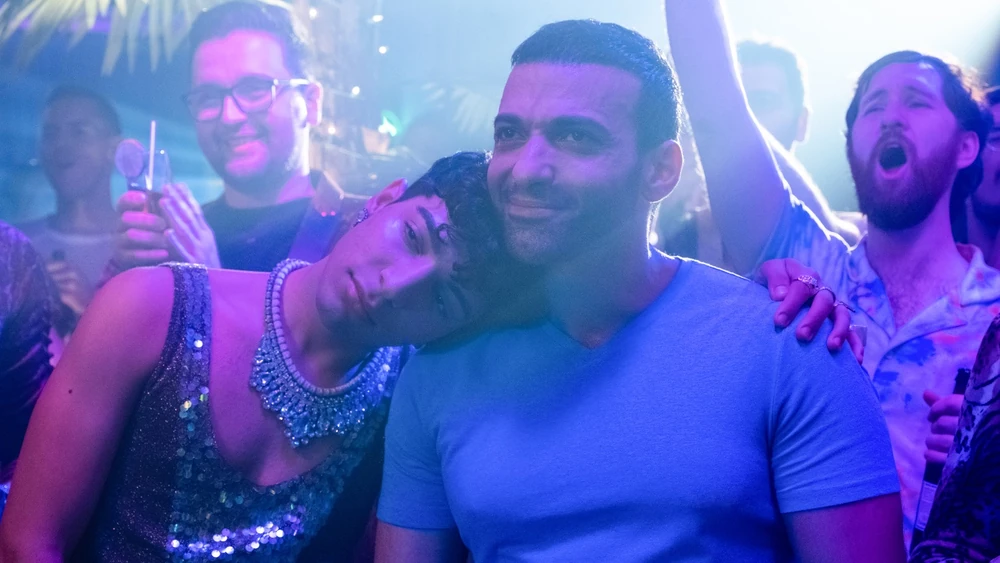
When I read the interview with Haaz Sleiman, the actor who played Rafiq, I felt really inspired. He talked a lot about how this story is very close to his own life and how proud he was to show an Arab gay man on screen in a real, honest way. He said that when he was younger, he didn’t see people like himself in movies, so he wanted to change that. He wanted to show that everyone has a story and deserves love and understanding.
He also spoke about how hard it was to make this film, because it’s about a subject that many people in the Arabic culture don’t like to talk about. But he said that art is supposed to open hearts and minds. I liked that a lot because it shows courage. For me, he’s not just an actor — he’s someone who used his talent to make people feel something real.
My reaction to the trailer and the actor’s message
When the actor said, “It is very important for us to give this story justice so that everyone who sees it will be moved and hopefully changed,” I agreed with him completely. I think he said “changed” because he hopes people will stop judging others and start understanding that love is love, no matter who it’s between. Stories like this can really open people’s eyes.
I was surprised to know the video was banned in some Arabic countries and in Russia. I don’t think that’s right, because movies like this can help people learn and grow. When we hide stories, we hide people’s pain too. I think everyone should be free to see and feel what they want. When I read about the problems they had filming it, I respected the actors even more — they didn’t give up, even when it was hard.
My reaction to the character Rafiq
When I watched the film, I really felt for Rafiq. He was trying so hard to be accepted by his family, but he also wanted to be true to himself. It’s not easy to live between love and fear. I could see his pain when he left his home, but I also saw hope in his eyes when he started a new life. That part really touched my heart.
I didn’t feel angry, but I did feel sad and emotional. When he finally smiled and danced freely, I was happy for him. It was like he finally found peace. This film made me think about how important it is to respect people for who they are. Even if we don’t fully understand someone, we can still show kindness and empathy.
Breakaway – the song and its message
When I listened to Kelly Clarkson’s song Breakaway, I understood why Zain said it was his favorite. The song talks about breaking free, finding your own path, and believing in yourself even when life is hard. The words are very strong — “I’ll spread my wings and I’ll learn how to fly” — it means being brave enough to start again.
This song also touched me personally because I came to a new country and started my life again. I left my comfort zone, just like Rafiq. Sometimes it’s scary, but it’s also beautiful to grow and find your own way. That’s why I think the song isn’t just for Rafiq or Zain — it’s for anyone who wants to follow their dreams and be free.
My Relationship with My Father
When I was young, my father was very strict but loving in his own way. He worked hard and didn’t show his emotions much, but I always knew he cared. When I became a teenager, we had more distance because I wanted to live differently, but now as an adult, I understand him more. Time helped me see that everything he did came from love.
In the last scene of the film, when Rafiq’s father read the letter, I felt a deep sadness and hope at the same time. The letter was short, but it carried a lot of love. It showed that even if words are few, they can still touch the heart. That moment reminded me that no matter how hard life gets, family and forgiveness always matter.  WU XUE
“Hopefully changed”
I think the author hopes people could treat queer people as common individuals and give them more understanding as well. He wants to tell the audience that gay people also have their emotions and the right to choose. They are just ordinary people, and there is nothing special about them. This film was banned in ten Arabic nations and Russia. I think it’s appropriate because every nation has its own rules, customs, and things that are limited or not allowed. If we want to give the group more inclusion, we also need to respect the nations that have different customs.
Your general reactions to the film
For me, it’s weird. Especially when two men are kissing or something, but if there are two girls, that is more acceptable. Actually, I don’t like to see scenes like this because I am a traditional person in this way. I think this is against natural rules, morality and ethics. If I don’t like them, I just walk away and I won’t judge them. In the meantime, I won’t encourage this behavior. If most people are like this, the world will be mixed up. Humans will end up. You may say you can adopt a child or utilize technology to have one. Human rules will be changed totally. And congratulations, you will be entering a new century. I don’t like things running this way. DMITRII
Breakaway – the song and its message
This is a very interesting song. I have never listened to this song before. I’m not saying it’s a great song, it’s a good song with a deep meaning. This is a song about how a person is not heard, not noticed, but he wants to break out of the cage and be happy. I think this song should appeal to many people.
My Relationship with My Father  I thought I said I had a great relationship with my father. His name is Nikolai. He was born in Norilsk, Siberia. The city is located beyond the Arctic Circle and is in the permafrost zone. Winter: Lasts about 240 days a year.
What I like about him is that he always bought me and my sisters things when we were kids that my mother forbade him to do, he never yelled or punished me or my sisters in his life, he is an incredibly kind person. My father instilled in me and my sisters a love of sports. I love him because he never interfered in my life after 20 years. He always said that he trusted me and my sisters and was sure that we wouldn’t do anything bad, It’s a pity that my mother had the opposite opinion.
My dad was born and raised in the Soviet Union, he always taught me and my sisters that if you want something, you need to work, be willing to learn new things, and respect people. My dad is the complete opposite of my mom – calm, likes to debate, friendly. Whenever I had a fight with my mom, I always complained to my dad. I asked him, “How did you come to love our mother? She’s a monster.” He always answered, “Deep down she’s beautiful, I know that!”
I want to talk a little about this episode. I often hear among emigrants from Russia a not very good attitude towards people like Rafik. I absolutely disagree with this attitude, this is America, the land of freedom, and freedom is not something personal or specific – it is freedom for everyone! Of course, there is often no middle ground in America. Plus, it often drifts from side to side.
We must respect each other – always! TANYA
Breakaway – the song and its message  The song Breakaway is about overcoming fears, insecurities, breaking out into the big world, spreading your wings to learn how to fly and follow your dreams no matter what. I think Zain loves this song because its lyrics resonate with him, with his desire to go to the big city, to become famous, it gives him strength. As for me, this song also resonates with me, it seems to give me the strength to not be afraid, to follow my goals.
At the end, the actor who plays Rafiq says, “It is very important or us to give this story justice so that everyone who sees it will be very moved, and hopefully changed.” Your thoughts?
I think in the actor’s phrase “It is very important for us to give this story justice so that everyone who sees it will be very moved, and hopefully changed.” by the word “changed” he meant to change people’s minds. Even if people are more developed now, more aware of the existence and normality of different sexual orientations, there are still those who are against it, who still think it is wrong, so to speak, unnatural. I’ve noticed this kind of bad attitude and rejection a lot in other people who are disgusted just because someone loves someone of the same sex, although I think it’s very easy to understand compared to other things in life.
So the actor hoped that through this story others would see how many problems people like him are going through, how they are not accepted even by their closest ones. That others would feel sympathy and more understanding, that it would help change their minds. ALENA
Actor Haaz Sleiman shared in his interview that the themes of self-acceptance, immigration, and the father-son relationship have played a major role in both his life and his work. His role in Little America is deeply personal, reflecting the fear of rejection and the search for freedom. The loss of his father made the filming even more emotional, as he often struggled to control his feelings on set. Sleiman believes that an actor’s mission is to convey truth and humanity, to inspire others, and to help people understand one another — especially through LGBTQ and immigrant stories.
In my opinion, the story of Rafiq and Haaz Sleiman himself teaches us to respect other people’s choices, accept differences, and recognize everyone’s right to be themselves and to seek happiness. It shows how important it is not to judge but to understand — because behind every story is a person searching for love, freedom, and acceptance. JUAN
The interview with the actor who played Rafiq
He has a tough story too, different in some aspects than Rafiq’s but difficult enough to make you think about life. The reality of so many people struggling with so many different kinds of problems in their lives, in the case of Rafiq and the actor who plays his role, is a different sexual orientation just with the aggravating factor of the “radical” culture and social environment where they borned.
It is also very impactful that the actor had to play this role while he was dealing with the terrible fact of losing his dad, and furthermore, in the chapter, one of the main topics is the relationship between Rafiq and his dad. So I can imagine the sadness of the actor when he was in that process creating a character with a story so similar to his own. Gladly, he mentioned that a short time before his dad died, he had called him to express his love and his support no matter what other relatives thought about his son’s decision.
At the end of the trailer, the actor says: “It is very important for us to give this story justice so that everyone who sees it will be very moved, and hopefully changed.”
I agree with him, the episode is very well done and accomplishes that purpose of giving justice to the story of Rafiq, a story that before the episode, like a lot of people’s story, was not known. Just the fact of showing stories like that to the world allows each viewer to think about it, to meditate on it and hopefully to change the way of thinking in the more radicals. ERIK M.
My Relationship with My Father
To be honest, the relationship between my father and me was very weak. My father usually didn’t talk to me. He didn’t teach me anything. He didn’t tell me how I should act at any time. I grew up by myself. I learned everything myself. I didn’t have an older brother and sometimes I felt sad, because I saw my friends with older brothers and how they cared for them.
So now I have my own son and we have a great relationship! I think that is true because I would never tell my dad any secret, but my son tells me. And also we can easily hug each other. I never hugged my dad.
Now I know what sons expect from their fathers. MARCELA
Summarize the important ideas that the actor shares with us about his life, about making the film, and about the themes of the film.
Haaz Sleiman is the actor who represents Rafiq in the Little America episode “The Son,” which tells the true story of a gay Syrian man forced to flee after his father discovered his sexuality. The role really connected with Sleiman, who is also gay and grew up in Lebanon where he lived the same kind of isolation and emotional struggles. He connected personally with the character because of the fear of rejection and the feeling to need to escape from his country to survive. The film is especially emotional because Sleiman’s father had recently passed away, and their relationship had been complicated until before short time his death. However, Sleiman used his grief to drive his performance.
In the same way , he had to balance genuine emotion with what the scenes required. Otherwise, meeting the real Rafiq at the premiere was impactful; he got emotional and started crying, showing that Slieman really got it right. Sleiman believes artists have a responsibility to represent the truth, inspire others, and humanize difficult stories. He sees Little America as an important series because it fights against social division by showing what immigrants go through and what we all have in common.
Likewise, Sleiman continues LGBTQ representation through his role in Marvel’s Eternals, proud that the film includes a queer family. For Slaiman, an artist’s strength comes from adding something good to the world, telling the truth, and having more empathy and awareness about the world.